[00:00:21] Speaker A: If you dig the twisted, admire the outlandish, and are enamored by the unusual, you're in the right place.
True crime, the supernatural, the unexplained. Now you're speaking our language. If you agree, join us as we dive into the darker side. You know, because it's more fun over here.
Welcome to Total Conundrum Warning. Some listeners may find the following content disturbing. Listener discretion is advised.
[00:01:00] Speaker B: Imagine you're eight years old, innocent, wide eyed, maybe still figuring out multiplication tables. Now imagine another 8 year old standing waist deep in a harbor, holding your head underwater until you stop moving. Until you're gone.
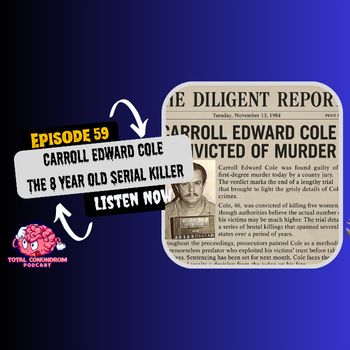
[00:01:17] Speaker A: That's not fiction. That's not a horror movie. That's the real life beginning of Carol Edward Cole and a serial killer who didn't wait until adulthood to start killing. He got an early start and no one noticed.
[00:01:31] Speaker B: For decades, Cole flew under the radar. A quiet guy with a troubled past, a genius IQ and a fury that burned just beneath the surface. He confessed to 13 murders, maybe more. But his story, it's one of missed chances. Red flags ignored, A trail of victims stretching from California to Texas.
[00:01:54] Speaker A: He strangled, he buried, he vanished. Sometimes he even turned himself in just to be brushed aside. Hospitals, jails, courts, they all had a chance to stop him. But Cole always slipped through the cracks.
[00:02:09] Speaker B: Tonight we're diving into the twisted life of a man who started killing in childhood and didn't stop until the state of Nevada finally said enough.
This is one of the most chilling cases we've ever covered and and yet barely anyone talks about him.
[00:02:26] Speaker A: So buckle up Conundrum crew because this isn't just a true crime story, it's a full on system failure with a body count. And if you're into deep dives like this, make sure to follow, rate and subscribe on your favorite platform.
[00:02:40] Speaker B: And hey, if you've got a creepy hometown story, a brush with a killer, or a place we just have to check out, head to Total Conundrum.com or DM US on Insta or Facebook or we love hearing from you. Just maybe not if you're writing from a crawl space. Carol Edward Cole was born on May 9, 1938 in Sioux City, Iowa. On paper, it started just like any other American story. But by the time he was in elementary school, things had taken a disturbing turn.
[00:03:12] Speaker A: His family moved to Richmond, California. And not long after his father was drafted into World War II.
That left young Carol in the care of his mother, Laura, a woman who would play a key role in shaping the man he would become. And not In a good way.
[00:03:28] Speaker B: Yeah, not even close.
Laura's parenting style. Let's just say it was less hugs and bedtime stories and more intimidation and emotional whiplash. She belittled him constantly, made him feel weak, and even by multiple accounts, dressed him in girls clothing to embarrass him.
[00:03:49] Speaker A: And on top of that, she wasn't exactly discreet about her personal life. She turned to prostitution while her husband was at war. She'd leave Carol in questionable environments while she met up with men that allegedly punished him. If he showed any reaction, he learned early that his voice didn't matter. And neither did boundaries.
[00:04:10] Speaker B: At age 7, things escalated.
One day, after being mocked by the other kids in the neighborhood for his name, Carol lost control of his emotions. He blacked out. And when he snapped out of it, he realized he had killed the family's puppy.
[00:04:27] Speaker A: That moment stuck with him, and so did the reaction. Or rather the lack of one. No one really addressed it. No one asked why it was brushed off. And he learned something from that.
People didn't see what he was capable of.
[00:04:42] Speaker B: And the very next year, it got worse. Carol was 8 when he and a group of boys went swimming at the Richmond yacht harbor. But after everyone else left, he stayed behind with one classmate, Dwayne.
[00:04:56] Speaker A: Dwayne had been one of the kids who had teased him. According to Cole's later confessions, that moment, just the two of them at the water's edge, was when he acted. Dwayne never made it home.
[00:05:10] Speaker B: The death was ruled a tragic accident. No one suspected otherwise. But Carol later admitted that it wasn't an accident at all. He'd done it on purpose and gotten away with it.
[00:05:23] Speaker A: Let that sink in. At just 8 years old, Carol Cole made a decision that changed everything. And no one had any idea.
[00:05:32] Speaker B: After that, he. His thoughts started turning darker. He developed obsessive fantasies about hurting women who reminded him of his mother. Women he believed were cruel, manipulative, or immoral.
[00:05:46] Speaker A: So here's a kid who has been emotionally isolated, humiliated, and left unsupervised. And by the third grade, he's already crossed a line most adults can't even comprehend.
[00:05:58] Speaker B: And no one stopped him.
No one even saw it coming.
[00:06:03] Speaker A: But the warning signs didn't go away. In fact, they multiplied. And next up, we'll walk through the teenage years that proved over and over again that something was deeply wrong. By his teenage years, Carol Edward Cole was already showing signs of serious internal conflict. On the surface, there was potential.
His IQ tested at an astonishing 1152 genius level.
[00:06:31] Speaker B: But what did he do with it? Absolutely nothing. His grades hovered around a D plus and he dropped out midway through his junior year. He wasn't thriving. He was slipping through the cracks and fast.
[00:06:46] Speaker A: By the time he was 20, he'd already racked up multiple arrests. Burglary, auto theft, alcohol abuse. He wasn't exactly easing into adulthood.
[00:06:56] Speaker B: In 1957, he joined the Navy and it went exactly like you'd expect.
Within a year, he was dishonorably discharged for, you guessed it, more drinking and theft. Oh, and he also got caught stealing military issued guns and selling them on the side.
So, yeah, not exactly the structure he needed.
[00:07:19] Speaker A: After that, things got even more erratic. He bounced between jobs, cities, and increasingly disturbing behavior. What's wild is that around this time he started asking for help.
[00:07:32] Speaker B: That's the part that really stands out. In 1961, Cole flagged down a police officer in Richmond and confessed that he was having violent urges. He specifically said he wanted to harm women. And the officer? He told Cole to admit himself to a mental hospital.
[00:07:50] Speaker A: Which might sound like the right move. But what followed was a year long carousel of diagnosis and missed opportunities. Cole entered Napa State hospital for a 90 day observation.
While there, he painted a rosy picture of his childhood, leaving out all the trauma, and refused to talk about the darker stuff.
[00:08:11] Speaker B: The staff still knew something was off. They diagnosed him with antisocial personality disorder, noted his sadistic and abnormal sexual tendencies, and even warned that he could be a potential danger to women. And their big recommendation, discharge and maybe look into some outside counseling, maybe.
[00:08:34] Speaker A: Spoiler. He did not look into outside counseling.
[00:08:37] Speaker B: A few months later, he was back in the system, this time at Atascadera State Hospital, where doctors described him as emotionally dependent, confused about his identity and. And unstable.
[00:08:51] Speaker A: Eventually, he was transferred again, this time to Stockton State Hospital, where another doctor stated that Cole seemed incapable of having a normal relationship with women, that he feared them, that he felt compelled to hurt them. The diagnosis? Schizophrenic reaction, chronic indifferentiated type.
[00:09:13] Speaker B: Which, okay, sounds clinical, but basically they were saying his grip on reality was shaky and he couldn't form appropriate emotional bonds. And yet he was released again.
[00:09:28] Speaker A: Again.
Over and over, these institutions spotted the warning signs, but nothing stuck. No one followed up. No one monitored him long term. And in between diagnosis, he kept spiraling.
He even tried to strangle a woman in Dallas in 1963. When it failed, he attempted to take his own life and landed in a psychiatric ward again, but just for four days.
[00:09:55] Speaker B: Four days after a violent attack and a suicide attempt, four days There were.
[00:10:04] Speaker A: Signs, there were confessions. There were literal red flags stapled to the guy's forehead. But instead of being stopped, he was shuffled along.
[00:10:15] Speaker B: And all of that was before his first confirmed murder.
[00:10:19] Speaker A: So far, we've got an unstable teen with a genius iq, a long criminal rap sheet, a backpack full of untreated trauma, and an urge to strangle women. The question isn't how did this happen, it's how did it take so long?
[00:10:36] Speaker B: And coming up, the we finally cross the line. Because in 1971, Carol Cole stops talking about killing and starts doing it.
By the early 1960s, Carol Cole wasn't just fantasizing anymore. He was testing the waters. And like everything else in his life, no one seemed to connect the dots.
[00:10:58] Speaker A: In 1960, he took a pretty bold step. He approached a couple at Lovers Lane, then attacked them with a hammer. No real explanation, no robbery, no known motive, just straight up violence.
[00:11:13] Speaker B: Thankfully, the couple survived and Cole was arrested. He was convicted of assault with a deadly weapon, but his sentence, just 30 days in a county work camp.
[00:11:24] Speaker A: 30 days for a hammer attack?
[00:11:27] Speaker B: Yep.
Then came one of the most disturbing moments of his life. The something that should have landed him in prison for decades. In 1967, he broke into the bedroom of an 11 year old girl in Lake Ozark, Missouri and tried to strangle her while she slept.
[00:11:45] Speaker A: She survived, thank God and coal. He ended up pleading to a reduced charge. The result, a five year prison sentence, which for that level of violence, feels like almost a plea deal with the devil.
[00:11:59] Speaker B: By this point, the pattern was clear. Cole had violent urges and the people around him either minimized or completely missed the threat. He wasn't just spiraling, he was accelerating.
[00:12:12] Speaker A: When he got out in 1970, he headed to Reno, Nevada, and almost immediately, he started trying to act on his fantasies again. He attempted to strangle two women he met at a bar, but both managed to escape.
[00:12:27] Speaker B: And here's where it gets even more frustrating. After those attacks, Cole walked into a police station and confessed. He told him he was having urges again, that he wanted to kill. He flat out asked for help.
[00:12:40] Speaker A: He was detained briefly. A psychiatrist diagnosed him with antisocial personality disorder, alcoholism, and compulsive thoughts about harming women.
[00:12:52] Speaker B: Sounds like the system finally clicked in. Right? Maybe a long term hold treatment?
[00:12:57] Speaker A: Nope. Just kidding. The doctor retracted the diagnosis, saying Cole was likely faking symptoms to get food and shelter. They literally said he was manipulating the system for a warm bed.
[00:13:10] Speaker B: So instead of treatment, they bought him a bus ticket to San Diego and waved goodbye. That was it.
No follow Up. No check ins, no alert to authorities where he was going.
[00:13:23] Speaker A: And San Diego, by the way, is exactly where the body count begins.
[00:13:28] Speaker B: This was their last chance to stop him. After this, people start dying. And Cole, he starts to feel invincible.
[00:13:37] Speaker A: Coming up. Bar room pickups, shallow graves. And one of the most bizarre honeymoon arrests we've ever heard of.
The murders of Carol Edward Cole are about to begin. By 1971, Carol Edward Cole was done fantasizing. He pushed the limits, confessed the urges, and still nobody stopped him. So he stopped asking and he started killing.
[00:14:01] Speaker B: His first confirmed murder happened on May 7, 1971, in San Diego. He met Essie Buck, a 39 year old woman at a bar.
They talked, drank, and went back to his car. That's where he strangled her and kept her body in the trunk overnight.
[00:14:19] Speaker A: Then two days later, on his 33rd birthday, mind you, he drove out and dumped her body like it was some kind of birthday ritual.
[00:14:28] Speaker B: A few weeks later, on May 23rd, he struck again.
The woman who was only known as Wilma. He picked her up, brought her out to the edge of San Ysidro and. And strangled her. He later claimed to have buried her near the area, but her body was never recovered.
[00:14:47] Speaker A: And it didn't stop there. A week later, May 30, Cole killed another woman. Her identity remains unknown and details are scarce. What we do know is that she was yet another victim. Discarded and forgotten. He was spiraling fast.
[00:15:05] Speaker B: By the summer of that same year, he took two more women. One he beat with a hammer and the other he strangled. Classic coal. He buried both in the desert, never to be found. Five victims just like that in three months.
[00:15:23] Speaker A: And here's the thing. He wasn't hiding. He was just moving around, picking up women at bars, motels, city streets, and the leaving no trace. Unless he wanted to.
[00:15:34] Speaker B: In 1972, Cole met Diana Pashel, a barmaid in San Diego. Their relationship was anything but normal. He wasn't faithful, and neither was she. But for whatever reason, they moved in together and eventually got married in 1973.
[00:15:53] Speaker A: Yeah, I'm going out on a limb and say open marriage with a serial killer is not the secret to lasting love.
[00:16:00] Speaker B: I would say not.
Well, in 1974, they relocated to Las Vegas. Cole got a job transporting casino coins from the airport to casinos. And let's just say temptation won.
He stole an entire shipment of coins and vanished. Fled to Wyoming, leaving Diana behind.
Guess commitment wasn't really his thing.
[00:16:28] Speaker A: In August of 1975, Cole was back at it. He met Marlene Hammer, known as TP While partying, things got physical and afterwards he strangled her. Left her body on a hillside under an old sleeping bag.
[00:16:43] Speaker B: Her body was found the next day. But by then, Cole was long gone. This was becoming his cycle. Drink, hook up, kill, flee.
[00:16:54] Speaker A: May 14, 1977. Cole murdered Kathleen Blum, a 26 year old woman, and dumped her body in a stranger's backyard like it meant nothing.
[00:17:04] Speaker B: But what came next is perhaps the most disturbing chapter of this whole case.
[00:17:10] Speaker A: Later that year, around Thanksgiving, Cole City woke up in a motel and found a woman dead in his bathtub. According to his confession, part of her body were in the refrigerator and some had allegedly been prepared in a frying pan.
Little keante with your liver.
[00:17:30] Speaker B: No, no, no, no.
You are way too good at that. It is scary. Thank you.
And here's where things get a little murky.
Police were never able to identify the victim, and there was no forensic proof of cannibalism.
So while the claims were disturbing, they were never officially confirmed. Poof.
[00:17:56] Speaker A: She's gone. She vanished.
[00:17:57] Speaker B: Oh, no.
Too soon.
[00:17:59] Speaker A: Too soon.
Still, Cole was arrested, and get this. He received just six months in jail.
[00:18:09] Speaker B: Six months for being found with a dismembered body in a bathtub.
[00:18:15] Speaker A: I'm confused. I thought she just went poof and vanished.
I don't understand.
[00:18:23] Speaker B: I don't understand any of this. This is all insane.
How disconnected were these dots?
[00:18:32] Speaker A: Insane in the membrane, Insane in the brain.
Any Hootie in the blowfish. By 1979, Cole was back on the move and more dangerous than ever. On August 27th, he met Bonnie Sue O', Neill, a 39 year old woman. They had sex and afterwards she mentioned that she had to call her husband. That set him off big time.
[00:18:58] Speaker B: Cole strangled her and stuffed her body into a garbage can behind the building.
Like she was nothing or garbage.
Very true.
[00:19:09] Speaker A: She. He put her in a garbage can.
[00:19:10] Speaker B: And he has no respect for these women at all.
[00:19:13] Speaker A: Yeah, that's obvious. That's obvious.
[00:19:16] Speaker B: Okay, Captain Obvious. Tracy.
[00:19:21] Speaker A: Good one.
Three weeks later, on September 19, he murdered his own wife, Diana Cole. So I guess they got back together, huh?
[00:19:31] Speaker B: I guess so.
[00:19:33] Speaker A: So after the argument, he strangled her, wrapped her up in blankets and hid her in a closet. A neighbor eventually called the police after seeing Cold digging in the crawl space.
But somehow her death was ruled alcohol poisoning.
[00:19:49] Speaker B: Of course it was.
[00:19:50] Speaker A: Of course it was.
[00:19:52] Speaker B: So he killed his wife and walked away.
[00:19:55] Speaker A: It's crazy.
[00:19:56] Speaker B: It is insane.
[00:19:57] Speaker A: I mean, this is definitely a Tracy story. Because your stories are just kooky as hell.
[00:20:06] Speaker B: I've got to Find the good ones. The lesser known ones, I guess. I mean, not good. I shouldn't say good.
[00:20:12] Speaker A: Yeah, there ain't nothing.
[00:20:13] Speaker B: No, there's nothing good about this guy at all. But the lesser known, I. You know.
[00:20:19] Speaker A: Jesus.
[00:20:20] Speaker B: Yes, yes.
[00:20:21] Speaker A: And I get it.
[00:20:22] Speaker B: And I like to make you squirm.
[00:20:24] Speaker A: Oh, it's making me squirm. You got that?
All right, let's get back to it.
[00:20:31] Speaker B: All right.
[00:20:32] Speaker A: And then came Marie Cushman. On November 3, he met her at the Kasbah Hotel in Vegas. After killing her, he just left her body for the maid to find.
So basically, he's getting lazy.
[00:20:45] Speaker B: Very lazy.
[00:20:46] Speaker A: Yeah, I got a feeling he's gonna get caught here soon, right?
[00:20:50] Speaker B: I would hope so. And the thing is, is he hasn't had anything but just a mere slap on the wrist or turning himself in.
[00:20:59] Speaker A: Yeah, so he's feeling pretty cocky about himself.
[00:21:02] Speaker B: He is feeling very bold.
[00:21:05] Speaker A: Bold.
[00:21:06] Speaker B: And he wasn't hiding the bodies anymore, so he was getting sloppy. Or maybe he just wanted it to end.
[00:21:13] Speaker A: Oh, good one.
Because very soon after that's exactly what happened. He finally turned himself in. Which. What is this, like, the 12th time?
[00:21:24] Speaker B: At least.
And yeah, I'm surprised that they didn't just buy him a bus ticket and send them to another city.
[00:21:32] Speaker A: They probably did. He's off to Mexico now.
[00:21:35] Speaker B: Coming up, confessions, Cold justice, and the twisted reasoning behind Carol Cole's so called mission. He believed he wasn't just killing, he was cleansing. And he wanted the world to know.
[00:21:51] Speaker A: Exercise the demons.
[00:21:55] Speaker B: Okay, after that seriously grim stretch, I feel we need to hit the brakes just for a minute and give our brains a little break.
[00:22:05] Speaker A: Won't help.
Oh, you mean it's time for the most untrustworthy segment in podcasting. Welcome to Killer or Clickbait.
[00:22:15] Speaker B: Bring it on. I'm ready to sniff out some fake news or fall for it completely again.
[00:22:22] Speaker A: Here's how it works. I'm going to read off a few headlines. Some are 100% real and as in filed by a reporter who was also confused. Real or the others, complete fabrication. You tell me, is it real, killer, Real or clickbait? Total BS.
Man tries to rob a convenience store with a live raccoon as his accomplice. Killer or clickbait?
[00:22:46] Speaker B: Raccoon ride or die. That sounds nuts, but also exactly like something that would happen in the Midwest.
I'm saying killer.
[00:22:56] Speaker A: Correct. It happened in Ohio. The raccoon was detained but later released on good behavior.
[00:23:02] Speaker B: Probably the most competent sidekick he could have picked. And of course, it was in Ohio.
[00:23:08] Speaker A: Of course.
Florida woman arrested for throwing a frozen snake at a neighbor during HOA meetings.
[00:23:16] Speaker B: I want this to be true, but frozen snake as a weapon? That sounds like a myth level chaos. I'm going to say clickbait on that one.
[00:23:26] Speaker A: Yep, fate totally made up. But I'd watch the episode of Dateline.
[00:23:30] Speaker B: Honestly, if my HOA meetings had snakes, I might actually attend.
[00:23:36] Speaker A: All right, serial killer caught after leaving behind trail of Cheeto dust.
[00:23:42] Speaker B: All right, I think this rings a bell.
Orange fingerprints of doom. I'm going with killer real deal.
[00:23:51] Speaker A: Bingo. Oklahoma. 2021. She broke in, ate Cheetos, and left a snack trail straight to the cops.
[00:23:58] Speaker B: I mean, I get it, Cheetos are delicious, but maybe wipe your hands before fleeing the scene.
[00:24:05] Speaker A: Probably a good one. All right, bank robber stops mid heist to update Facebook status. Feeling cute, Might rob a bank. I don't know. Idk.
[00:24:14] Speaker B: Oh, no.
I want to believe no one's that dumb, but it's 2025. I'm saying killer real clickbait, but not far off.
[00:24:27] Speaker A: Someone did actually post a selfie during a robbery once. Not feeling cute level, but still dumb enough for the archives.
[00:24:35] Speaker B: I swear, social media is doing half of the detective work this these days.
[00:24:40] Speaker A: All right, next one naked man found in chicken Cooper claims he's the real Colonel Sanders.
[00:24:47] Speaker B: Come on, that has to be fake. Please tell me it's fake. I cannot deal with greasy poultry.
[00:24:55] Speaker A: Cosplay clickbait, thankfully. But don't tempt the Internet. It'll make it real tomorrow.
[00:25:01] Speaker B: Now I want to start a petition to revoke someone's WI FI privileges permanently.
Okay, that was weird. And hilarious. And exactly the brain cleanser that I needed after that coal carnage.
[00:25:15] Speaker A: Right. Sometimes it helps to remember that the world is terrifying in a different way, too.
[00:25:20] Speaker B: Back to the darkness.
[00:25:22] Speaker A: Let's do it.
[00:25:23] Speaker B: Coming up, we'll dive into what kind of killer Carol Cole really was and how he stacks up with some of the most infamous names in true crime history.
By the time Carol Edward Cole finally confessed, he didn't sound like a remorseful man. He wasn't haunted.
[00:25:41] Speaker A: He.
[00:25:41] Speaker B: He wasn't even nervous. In fact, he sounded like he believed he had a purpose.
[00:25:47] Speaker A: Cole claimed he wasn't just killing at random. In his mind, he was carrying out some kind of moral cleansing. He believed his victims, mostly sex workers, women who drank heavily or women who cheated, were immoral, just like his mother.
[00:26:03] Speaker B: To him, every woman he killed was some kind of stand in for his mother. And. And that was his twisted logic. He wasn't murdering strangers he was punishing symbols.
[00:26:14] Speaker A: He literally called himself an angel of death, a force sent to rid the world of what he saw as corruption. It wasn't about lust or thrill. It was about judgment.
[00:26:25] Speaker B: Which makes this somehow even creepier, because this wasn't a guy hunting for a high. This was someone who thought he was the judge and jury of morality.
And the sentence? Always death.
[00:26:39] Speaker A: Over the years, doctors slapped on several different labels. His diagnosis included chronic and differentiated schizophrenia, antisocial personality disorder, and signs of sadistic tendencies, especially in the way he fixated on control and emotional dominance.
[00:26:58] Speaker B: And while Cole denied that he got any sexual pleasure from killing, he. He did admit to having sex with some of the victims after death. He also hinted at least once that he might have cooked parts of one body.
[00:27:13] Speaker A: But again, let's be clear. There's no forensic confirmation of cannibalism, no physical evidence, just his word. And with Cole, separating fact from dramatic flare was always tricky.
[00:27:26] Speaker B: Which raises the question, was this a deeply disturbed man or a deeply manipulative one?
[00:27:32] Speaker A: Maybe both. He knew how to sound unhinged when it helped him. But when you read his confessions, there's planning, clarity, and chilling logic in his explanations. He wasn't operating in a fog. He was calculating.
[00:27:47] Speaker B: And that, honestly, might be the most terrifying part. Carol. Cole wasn't out of control. He was in control. And he liked it that way.
[00:27:58] Speaker A: Coming up, the confessions, the courtroom, and how one of America's most overlooked serial killers finally came to an end. And let's just say he had some words on the way out.
[00:28:09] Speaker B: Now that we looked inside Cole's head, let's zoom out and talk about what kind of killer he actually was.
Because not all serial killers fit the same mold. Some chase chaos, others follow rituals, and some, well, they believe they're doing society a favor.
[00:28:27] Speaker A: And Cole, he falls under what experts call a mission oriented killer. That's someone who believes they're eliminating people they see as unworthy or immoral. In Cole's case, that meant sex workers, women who reminded him of his mother, or someone he thought had crossed some moral line.
[00:28:48] Speaker B: Mission oriented killers aren't usually motivated by thriller fantasy. They're motivated by judgment. They kill with a purpose, even if that purpose is horrifying. Another example of mission type killers. Joseph Paul Franklin, who targeted people based on race in the 1970s and 80s. Terrifying stuff.
[00:29:11] Speaker A: But that's just one type. Here's a quick breakdown of the four major types of serial killers based on FBI profiling.
[00:29:19] Speaker B: Visionary. These killers believe they were compelled by voices or hallucinations. Like Herbert Mullen, who thought murders would prevent earthquakes. Yeah. Yikes.
[00:29:30] Speaker A: Mission orientated. That's our guy, Cole. He thinks he's on some righteous path.
[00:29:36] Speaker B: Hedonistic. These ones are in it for pleasure, sexual thrill or power. Think Ted Bundy, who killed for control and sadistic gratification.
[00:29:46] Speaker A: Power. Control orientated. They kill to feel dominant. Dennis Rader, AKA btk, is a textbook example. These killers enjoy the process, the fear, the control.
[00:30:00] Speaker B: And sometimes killers blur the lines. A little hedonistic, a little control driven. But Cole, he stayed squarely in the mission camp. Fueled by judgment, in a disturbing mother complex.
[00:30:13] Speaker A: He wasn't interested in elaborate rituals or games with police. He had one goal. Punish women who reminded him of everything he hated. And disturbingly, he believed he was doing the world a favor.
[00:30:26] Speaker B: So, yeah, this wasn't about chaos.
It was about twisted clarity. And once you understand that, his next move, turning himself in, Makes a strange kind of sense.
[00:30:38] Speaker A: Coming up, Cole confesses to the murders, details the unknown victims, and finally faces the consequences that were decades overdue. All right, before we get into Carol Cole's long overdue confession, we thought we'd test your true crime chops with a little something we like to call true crime trivia Throwdown.
[00:31:02] Speaker B: I'm ready. I've had coffee. I've read weird FBI files for fun. Let's go.
[00:31:09] Speaker A: Okay, trivia, round one. Which killer gave himself the nickname the Kindly Killer in letters to police?
[00:31:17] Speaker B: Oof, that sounds like something extra creepy. I'm gonna guess Dennis Nielsen.
[00:31:24] Speaker A: Correct. Ding, ding, ding, ding, ding.
Nielsen. The British serial killer who murdered young men in the 1970s and 80s, called himself kindly while keeping body parts in his flat?
[00:31:37] Speaker B: Ah, yikes. That's not how kindness works.
[00:31:41] Speaker A: Next one. How many active serial killers were estimated to be operating in the US in 1974? Your options are. A14, B36, C119.
[00:31:55] Speaker B: All right, 1974 was peak serial killer era, right?
I'm gonna go with C 119.
[00:32:03] Speaker A: Correct again. According to some FBI estimates, the US had over a hundred active serial killers in the mid-70s. It was a literal crime wave.
[00:32:13] Speaker B: That's not a wave. That's a tsunami. Makes you appreciate caller ID and DNA kits.
[00:32:20] Speaker A: All right, final question. What notorious serial killer passed two lie detector tests and and was still considered a suspect the entire time?
[00:32:29] Speaker B: Ooh, that sounds like Ted Bundy, but he was usually pretty cocky. I'm gonna say Ed Kemper.
[00:32:37] Speaker A: Ah, close, but it was Gary Ridgeway, the Green River Killer. He managed to fool polygraphs and still went on killing for Years.
[00:32:47] Speaker B: Dang.
That guy had a poker face of the century.
[00:32:52] Speaker A: How'd you do? Conundrum crew? If you got three out of three, you're officially smarter than a profiler in 1978. Let us know how you scored in the comments or tag us in your victory dance.
[00:33:04] Speaker B: And if you missed all of them, hey, there's always extra credit. Like sending us your favorite obscure case to cover.
[00:33:11] Speaker A: All right, quiz time over. Back to the case and the next part Cole finally tells all.
[00:33:18] Speaker B: Coming up, the confession, the body count, and the moment he walked into the police station. Like it was just another errand on his to do list. By 1980, Carol Edward Cole had killed across multiple states, with bodies scattered and several never even identified.
But it wasn't a grand confession that brought him down. It was something way more mundane.
[00:33:41] Speaker A: Yep, he was arrested during his honeymoon. He had just married his third wife, a woman he worked with at a religious charity. And they were off celebrating when they got pulled over by the police.
[00:33:54] Speaker B: Turns out Cole didn't have a driver's license. And when the officer ran his name, Boom. Parole violation warrant. Not exactly your standard honeymoon drama.
[00:34:06] Speaker A: He was taken into custody and transferred to a federal medical center for prisoners. And? And that's when the dam broke.
[00:34:14] Speaker B: Cole started confessing one by one, in graphic detail.
He admitted to 13 murders and even hinted that there could be as many as 35 victims. He strangled bodies he dumped. Some he buried in the desert, others never found.
[00:34:34] Speaker A: He wasn't trying to defend himself. He wasn't even asking for leniency. He just laid it all out like he just wanted credit for the chaos he caused.
[00:34:43] Speaker B: He even gave specific burial locations. But by that point, so much time had passed that not every body was recovered. Some victims were never even identified. They're just gone.
[00:34:57] Speaker A: So while his final arrest wasn't dramatic, it was a routine traffic stop. It turned out to be the end of the line for Cole and the beginning of a long list of confessions that finally forced the justice system to listen.
[00:35:11] Speaker B: Coming up, the trial, the sentencing, and the cold, detached final words of a man who spent his life thinking he was cleansing the world, when all he really did was destroy it.
[00:35:23] Speaker A: After years of chaos, confession, and a body count that likely reached into the dozens, Carol Edward Cole finally faced a courtroom.
[00:35:32] Speaker B: In 1984, he pleaded guilty to two counts of first degree murder in Nevada. And because this case was, well, a little beyond the standard jury box drama, the sentence was decided by a three judge panel.
[00:35:47] Speaker A: That panel didn't take long. They sentenced Cole to death.
[00:35:51] Speaker B: He was Transferred to Nevada State Prison, where he waited out the final chapter of his life.
No appeals, no no theatrics. Just cold acceptance, like he knew the ride was over.
[00:36:04] Speaker A: And on December 6, 1985, Carol Edward Cole was executed by lethal injection. No final pleas. No dramatic last meal.
[00:36:14] Speaker B: His last words were, well, honestly, just as chilling as the rest of his story. He said, I'd like to say I never really killed anybody. I didn't get to know them.
[00:36:26] Speaker A: Detached, ambiguous. Almost like he was trying to separate himself from it all. Like the murders didn't count because the people weren't real to him.
[00:36:36] Speaker B: And maybe that's the key to all of this. For Cole, people weren't people. They were just proxies for his mother, for the pain, for the control he never had.
[00:36:48] Speaker A: Whatever he was psychotic, sociopathic, sadistic. He was also a mirror, reflecting just how many chances the system had and wasted.
[00:36:59] Speaker B: Coming up, our final thoughts on Cole's legacy. The warning signs missed. And what happens when monsters don't hide under the beds but walk straight through the front door.
By the time Carol Edward Cole was executed, the question wasn't just how many people he killed, and it was how many could have been saved.
[00:37:20] Speaker A: Because let's be honest, this wasn't a case of a silent predator hiding in the shadows. Cole wasn't secretive. He told people what he was thinking, what he wanted to do, and what he was going to do.
[00:37:34] Speaker B: He confessed to police officers multiple times. He admitted violent fantasies. He walked into hospitals and courts and said, I'm not safe.
[00:37:44] Speaker A: And over and over, the response was basically, here's a bus ticket. Good luck.
[00:37:49] Speaker B: Seriously, how does someone attempt to strangle a child, get diagnosed as a danger to women, literally getting caught red handed with a body and still end up walking free with no permanent monitoring?
[00:38:05] Speaker A: There were hospital reports that labeled him as sadistic, emotionally unstable, and sexually violent. There were probation violations, violent assaults, and even attempted murder. And yet, every time he slipped through the cracks.
[00:38:21] Speaker B: One psychologist even said Cole could not be intimate with a woman unless she was dead. That statement alone should have triggered for a permanent hold or supervision.
Instead, he was placed on buses, shuffled between facilities, and forgotten.
[00:38:39] Speaker A: He gamed the system. And let's not pretend the system didn't make it easy for him.
[00:38:44] Speaker B: And here's the thing that really sticks with me. If just one red flag had been followed up on how many lives would have been saved, we'll never know.
[00:38:54] Speaker A: And that's the tragedy buried beneath the body count.
[00:38:58] Speaker B: Cole's story is more than just a tale of murder. It's a lesson in what happens when we don't take people seriously, when confessions are dismissed, when diagnosis aren't enforced, and when victims are seen as disposable.
[00:39:14] Speaker A: It's a cautionary tale, one that ended in execution, but started with a drowned child and a room full of people who didn't want to deal with the truth.
[00:39:24] Speaker B: So now that we've unraveled the story of Carol Edward Cole, the violence, the confessions, the system that shrugged, the it leaves us with one huge question.
Could any of this have been prevented?
[00:39:38] Speaker A: It's a tough one. Cole had a tragic childhood, sure, but a lot of people experience trauma and don't turn into serial killers. At the end of the day, he still made those choices over and over again, right?
[00:39:51] Speaker B: But there were so many red flags. Diagnosises, warnings, even literal confessions.
If even one of those had been taken seriously, could it have stopped him before the body count hit double digits?
[00:40:06] Speaker A: That's where we want to hear from you, Conundrum crew. Head over to our Instagram or threads and weigh in. Do you think early intervention could have saved lives? Or was Cole just wired to kill?
[00:40:18] Speaker B: No matter what polls, comments, DMs, we're here for all of it. And if you've got your own story, something eerie, unexplained, or just plain weird, send it to
[email protected] you might just hear your mystery featured on the show.
[00:40:35] Speaker A: Speaking of which, next week, we're leaving Earth entirely. Well, kind of. We're diving into one of the most credible UFO encounters ever reported.
A schoolyard full of children, dozens of witnesses, and a message they say wasn't just seen, but felt.
[00:40:53] Speaker B: That's right, we're talking about the aerial school UFO incident. Kids. Aliens. Zimbabwe. Telepathic communication. If you haven't heard this one, prepare to have your mind beamed.
[00:41:08] Speaker A: So hit that follow button, subscribe wherever you're listening and maybe leave us a review so more people can find these stories that live in the shadows.
[00:41:16] Speaker B: Until next time, stay curious.
[00:41:19] Speaker A: Stay.
[00:41:19] Speaker B: Stay creepy and keep on creeping on. We love you.
[00:41:23] Speaker A: Bye.
Thanks for hanging out with us here at Total Conundrum. Please make sure to check out our website and
[email protected] for news, upcoming events, merch bloopers, and additional hysteria. You never know what will pop up, so be sure to follow along. If you want to show your support for Total Conundrum and gain access to all of our bonus content, please visit our Patreon page. You can also follow us on Facebook and Instagram and Twitter. The links are available in our Show Notes. If you have any questions, comments, recommendations or stories to share, please email
[email protected] episodes are available on Apple Podcast, Spotify or wherever you listen to your favorite podcasts. If you like the show, please rate, review and subscribe on Apple Podcasts. We appreciate the love. Keep on creeping on Mother Cluckers.
[00:42:42] Speaker B: Sam.